Sodium bicarbonate is usually known by the household name, baking soda. This product is a base that reacts with acids in a reaction called neutralization. Neutralization with sodium bicarbonate usually produces dioxide gas. Because of the danger of administering sodium bicarbonate intravenously, the injectible form is only available with a prescription.
Usage
Sodium bicarbonate is used as an antacid, a cleanser, and to replenish electrolytes. For years, it has been common practice to administer small quantities of sodium bicarbonate or other alkalinizing agents prior to a race.
Theory suggests that a small amount of sodium bicarbonate will help the horse recover after a race by dissipating muscle lactate. It is also used to prevent "acidosis," related to high grain intake. So far, there is no scientific basis to support these supposedly beneficial effects.
Sodium bicarbonate is also used to treat metabolic acidosis associated with colic in horses.
Dosage and Administration
Sodium Bicarbonate
Method
Dosage
(click row for calculator)
Concentration
Period
Duration
Oral
30 g
Twice daily
NA
Intravenous injection1
8.4 mg/lb 2
8.4 mg/ml
Treatment
NA
Notes:
1Rapid injection of Sodium Bicarbonate may be extremely dangerous and may cause death by severe derangement of intra or extra-cellular ionic concentrations. Hypertonic solutions must be employed with special care. In general, 1 or more liters of isotonic sodium bicarbonate may be administered to relieve acidosis. Because of the possibility of producing alkalosis by over-correction of the bicarbonate deficit, repeated fractional doses should be used. Thus, the actual total amount of sodium bicarbonate given is governed by the successive clinical response in patients to each repeated fractional dose. Once the severe symptoms have been controlled, the size of each fractional dose and the frequency of administration should be decreased in order to gradually restore normal bicarbonate levels.
Caution should be exercised in patients with oliguria or anuria so that excessive retention of sodium will not occur.
2 If the carbon dioxide content of the plasma is unknown, an average dose would be 1 ml. of undiluted sodium bicarbonate injection per pound of body weight administered in a liter of 5% Dextrose, or isotonic saline, or other appropriate fluid therapy vehicle.
Federal law restricts this drug to use by or on the order of a licensed veterinarian.
Extra-label use of drugs in treating animals is allowable only by licensed veterinarians within the context of a valid veterinarian-client-patient relationship, and does not include drug use in treating animals by the layman (except under the supervision of a licensed veterinarian).
The duration of administration depends on the condition being treated, response to the medication and the development of any adverse effects. Be certain to complete the prescription unless specifically directed by your veterinarian. Even if your equine appears to feel better, the entire treatment plan should be completed to prevent relapse.
This medication may be available in forms and concentrations not noted in the above table. Always check the label and literature provided with the medication about the form and concentration and DO NOT USE the calculator if the information differs.
Calculator is for educational purposes only. Follow your veterinarian's instructions regarding use of this, or any medication.
Side Effects
None noted.
Precautions
In 1992, rules were introduced in horse racing codes to limit the amount of bicarbonate and related substances that can be administered to horses prior to racing. Check with the appropriate regulatory group in each case.


 Sodium bicarbonate is usually known by the household name, baking soda. This product is a base that reacts with acids in a reaction called neutralization. Neutralization with sodium bicarbonate usually produces dioxide gas. Because of the danger of administering sodium bicarbonate intravenously, the injectible form is only available with a prescription.
 Sodium Bicarbonate
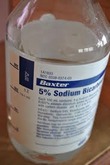 Baxter Sodium Bicarbonate Injection
 Finish Line Sodium Bicarbonate