
Pronunciation
a-set-uh-ZOL-uh-mide - Pronunciation guide
Brand Names
- AcetaZOLAMIDE Tablets
- Diamox (Human form)
Description
 Acetazolamide is a white to faintly yellowish-white, crystalline, odorless powder that is weakly acidic. Acetazolamide is supplied as a sterile powder, requiring reconstitution for intravenous use, as a bulk solution, and as capsules and tablets.
Acetazolamide is nonbacteriostatic sulfonamide, possessing a chemical structure and pharmacological activity distinctly different from bacteriostatic sulfonamides.
Research indicates that Acetazolamide is useful in the treatment of certain dysfunctions of the central nervous system that may lead to attacks of paralysis and muscle weakness.
Usage
Acetazolamide acts as a potent carbonic anhydrase inhibitor that is effective in control of fluid secretion. In the eye, this inhibitory action decreases the secretion of aqueous humor and results in a drop in intraocular pressure, making it useful in treatment of glaucoma in horses.
Acetazolamide has been found to be more effective than hydrochlorothiazide in controlling clinical signs of hyperkalemic periodic paralysis. This condition causes attacks of muscle weakness, stiffness, and, sometimes, muscle pain and irregular heartbeat in horses.
Acetazolamide is effective as a diuretic in cases of abnormal fluid retention. The diuretic effect of acetazolamide is due to its action in the kidney, resulting in renal loss of sodium, water, and potassium, leading to alkalinization of urine and promotion of diuresis in horses.
Acetazolamide is also used as an adjunctive treatment of edema due to congestive heart failure.
Dosage and Administration
 Acetazolamide Acetazolamide |
||||
|---|---|---|---|---|
| Method | Dosage (click row for calculator) |
Concentration | Period | Duration |
| Oral | 2-4 mg/kg | 125 mg/tablet | Every 8-10 hours | Clinical episode of HYPP |
| Oral | 2-4 mg/kg | 250 mg/tablet | Every 8-10 hours | Clinical episode of HYPP |
Notes:
|
||||
Side Effects
Acetazolamide may cause fatigue, drowsiness, fever, pain at injection site, gastrointestinal disturbances, blood dyscrasias, abnormal liver function, electrolyte imbalances, ataxia, convulsions, hearing disturbances, and myopia. Long term therapy may cause renal failure and increased risk of nephrolithiasis.
Precautions
Although rare, fatalities have occurred with use of acetazolamide, due to severe reactions to sulfonamides. If signs of hypersensitivity or other serious reactions occur, discontinue use of the drug.
Caution is advised when used with high-dose aspirin because of possibility of anorexia, tachypnea, lethargy, coma, and death.
Acetazolamide for injection may decrease serum concentrations of primidone.
Because of possible additive effects with other carbonic anhydrase inhibitors, concomitant use is not advisable.
Acetazolamide is not for use in pregnant mares.
Acetazolamide is FDA-approved for use in horses and is a prescription drug restricted to use by or on the lawful written or oral order of a licensed veterinarian.
Acetazolamide is a forbidden substance under AHSA and should not be used in competition horses. Check with appropriate regulatory group for rules and regulations.
Interactions
Acetazolamide and sodium bicarbonate used concurrently increases the risk of renal calculus formation.
Acetazolamide should not be used with high-dose aspirin therapy.
Acetazolamide may increase the effects of other folic acid antagonists.
Acetazolamide may increase or decrease blood glucose levels and care should be taken in horses being treated with antidiabetic agents.
Acetazolamide reduces urinary excretion of quinidine and may enhance its effect.
Acetazolamide may elevate cyclosporine levels.
Overdose
No specific antidote is known. Treatment should be symptomatic and supportive. Supportive measures are required to restore electrolyte and pH balance. The acidotic state can usually be corrected by administration of bicarbonate.
Acetazolamide may be dialyzable. This may be important in management of acetazolamide overdosage when complicated by renal failure.
Images
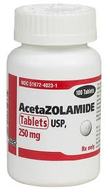 AcetaZOLAMIDE Tablets
Literature
Product labels
The drug labels on this website represent drug information listings as submitted to the FDA.The drug labels on this website have not been altered or modified by EquiMed. These labels may not be the most current or identical to the current labels shipped with the product. Contact your veterinarian or the manufacturer for the latest information on this drug or medication prior to use.
Some of the labels listed may be for drugs or medications not FDA approved for use in animals. These may only be used under the direct supervision of a veterinarian.